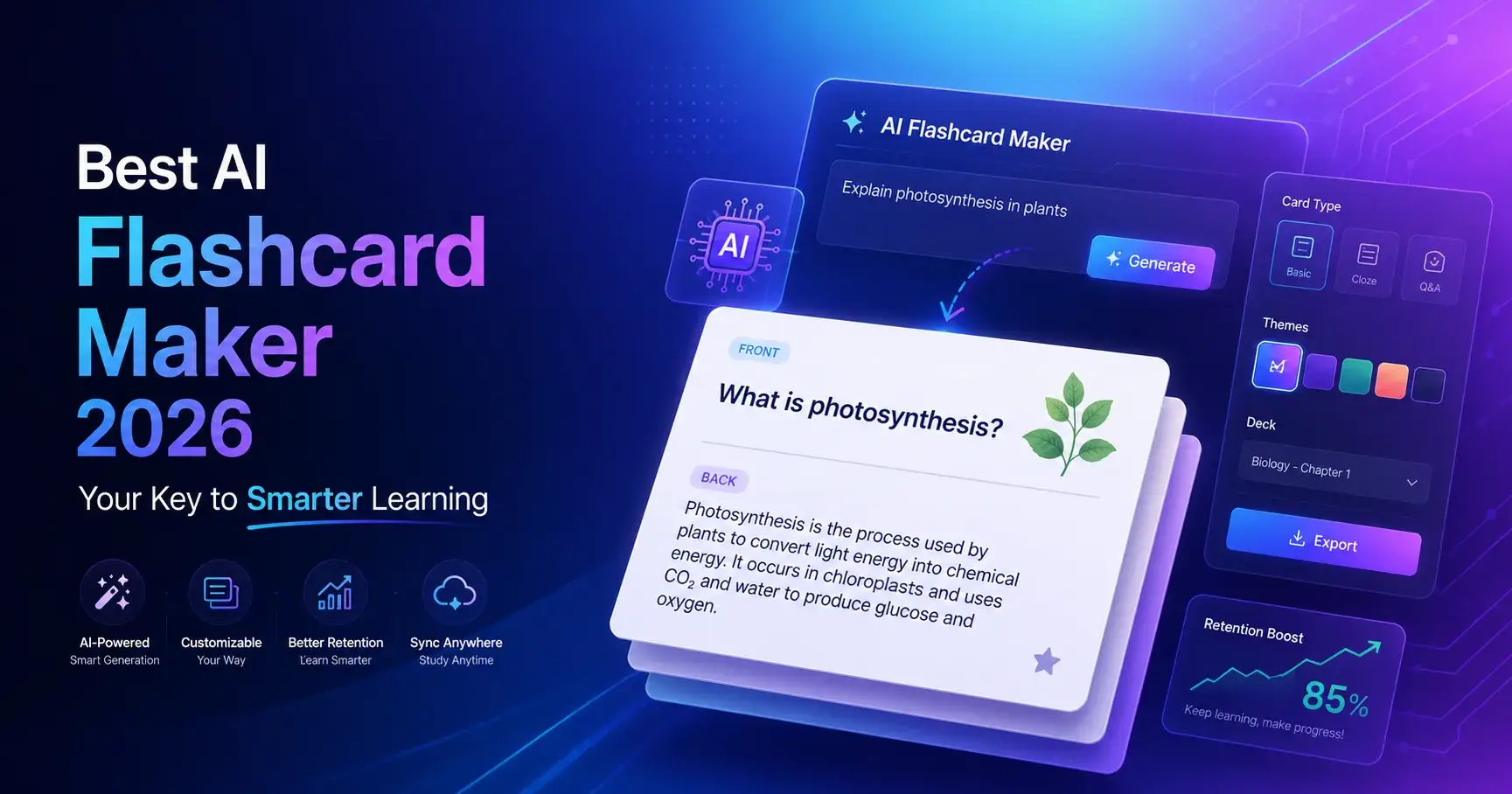
Modern education is rapidly evolving toward systems that prioritize efficiency, retention, and cognitive performance over traditional rote memorization. In this transformation, the flashcard maker has become a central innovation, reshaping how learners build, organize, and retain knowledge through structured recall and intelligent repetition. What was once a simple revision technique has now developed into a powerful learning system supported by data-driven insights and behavioral science.
Statistical learning patterns show that learners using structured recall tools consistently demonstrate higher retention rates and improved recall accuracy compared to passive study methods. This shift reflects a broader movement toward smarter, more adaptive learning environments that align with how memory actually works.
Why is memory retention the foundation of effective learning?
Memory retention is the core of effective learning because it determines how well knowledge can be recalled and applied over time. Without strong retention, even well-understood concepts can fade quickly, reducing academic and practical performance.
Advanced learning systems focus on reinforcing memory through repetition and structured recall. This ensures that information is not just understood temporarily but stored for long-term use. Strong retention also improves confidence, allowing learners to apply knowledge more effectively in real situations.
Statistically, retention-focused study methods outperform traditional reading-based learning by a significant margin in long-term recall accuracy.
How do advanced flashcard systems improve retention rates?
Advanced flashcard systems improve retention rates by combining active recall with spaced repetition techniques. Instead of reviewing information randomly, learners are guided through structured cycles of reinforcement.
This approach ensures that information is reviewed at optimal intervals, strengthening memory just before forgetting occurs. Over time, this repeated reinforcement builds stronger neural pathways, making recall faster and more reliable.
Data-driven learning models show that structured repetition significantly increases retention compared to unstructured study methods.
What makes flashcard-based learning more efficient than traditional revision?
Flashcard-based learning is more efficient because it focuses only on essential information and eliminates unnecessary repetition. Traditional revision often involves re-reading entire chapters, which can be time-consuming and less effective.
In contrast, flashcards break content into smaller, targeted units. This allows learners to focus on one concept at a time, improving clarity and reducing cognitive overload.
Efficiency is further improved through active engagement, where learners must recall answers instead of passively recognizing them.
How does active recall strengthen long-term memory?
Active recall strengthens long-term memory by forcing the brain to retrieve information without external cues. This retrieval process reinforces neural connections, making it easier to remember information in the future.
Each time a learner successfully recalls an answer, the memory becomes stronger and more stable. Even incorrect attempts contribute to learning by highlighting areas that need reinforcement.
Statistical evidence in cognitive science shows that active recall is one of the most effective techniques for long-term knowledge retention.
Why is spaced repetition important in modern learning systems?
Spaced repetition is important because it aligns with the natural forgetting curve of the human brain. Instead of reviewing material at fixed intervals, learners revisit content strategically over time.
This timing ensures that information is reinforced just before it is forgotten, improving long-term retention without excessive repetition.
Studies in learning behavior consistently show that spaced repetition leads to higher recall accuracy and better knowledge durability compared to traditional study schedules.
How do advanced flashcard systems personalize learning experiences?
Advanced flashcard systems personalize learning by analyzing user performance and adjusting study material accordingly. Learners receive more practice on weaker topics and less repetition on areas they have already mastered.
This adaptive approach ensures that study time is used efficiently and effectively. It also creates a more balanced learning experience tailored to individual needs.
Personalization improves motivation, as learners can clearly see progress based on their own performance data.
Can flashcard systems improve exam performance?
Yes, flashcard systems significantly improve exam performance by enhancing recall speed and accuracy. They simulate real testing conditions by requiring learners to retrieve answers without prompts.
This practice builds confidence and reduces anxiety during exams. It also helps learners identify weak areas that require additional focus before assessments.
Statistical learning trends show that students using active recall methods consistently achieve higher scores in timed evaluations.
How do advanced systems support better study habits?
Advanced systems support better study habits by encouraging consistency and structured learning routines. Learners are guided through regular review sessions that prevent last-minute cramming.
This structured approach promotes discipline and helps build long-term study consistency. Over time, learners develop stronger academic habits that improve overall performance.
Consistency supported by structured tools leads to better retention and reduced cognitive stress.
Why is engagement higher with flashcard-based learning?
Engagement is higher because flashcard systems require active participation rather than passive reading. Learners are constantly interacting with content through recall and response.
This interactive process keeps attention focused and reduces distractions during study sessions. Higher engagement levels naturally lead to better retention and improved understanding.
Learners are more likely to stay motivated when they can actively measure their progress.
How do flashcard systems handle complex subjects?
Flashcard systems handle complex subjects by breaking them into smaller, structured components. Each concept is simplified into digestible units that are easier to understand and remember.
This segmentation helps reduce cognitive overload and makes challenging topics more manageable. Learners can gradually build understanding step by step instead of trying to absorb everything at once.
Over time, this structured approach leads to deeper comprehension and stronger mastery of complex material.
What role does consistency play in memory improvement?
Consistency plays a critical role in memory improvement because repeated exposure strengthens recall pathways. Irregular study habits often lead to forgetting and weak retention.
Flashcard systems encourage daily or regular practice, ensuring that information is continuously reinforced. This steady repetition helps convert short-term memory into long-term knowledge.
Statistical learning behavior shows that consistent study routines significantly improve retention outcomes.
How do advanced flashcard solutions impact long-term learning?
Advanced flashcard solutions have a strong positive impact on long-term learning by combining repetition, recall, and personalization. These elements work together to improve memory stability and knowledge application.
Learners develop stronger cognitive abilities, better problem-solving skills, and improved academic performance over time. The structured nature of flashcard systems ensures that knowledge is retained for extended periods.
Long-term data trends consistently show improved outcomes among learners who use structured recall-based systems.
Conclusion
Advanced flashcard maker solutions have fundamentally transformed the way learning and memory retention are approached in modern education. By combining active recall, spaced repetition, and personalized learning strategies, these systems significantly improve efficiency, engagement, and long-term retention. As education continues to evolve, flashcard-based learning will remain a powerful and reliable method for building stronger memory, enhancing academic performance, and supporting lifelong learning success.